TRAFFIC LIGHTS
PROBLEM
In the city of Dingilville the traffic is arranged in an unusual way. There are junctions and roads connecting the junctions. There is at most one road between any two different junctions. There is no road connecting a junction to itself. Travel time for a road is the same for both directions. At every junction there is a single traffic light that is either blue or purple at any moment. The color of each light alternates periodically: blue for certain duration and then purple for another duration. Traffic is permitted to travel down the road between any two junctions, if and only if the lights at both junctions are the same color at the moment of departing from one junction for the other. If a vehicle arrives at a junction just at the moment the lights switch it must consider the new colors of lights. Vehicles are allowed to wait at the junctions. You are given the city map which shows
- the travel times for all roads (integers),
- the durations of the two colors at each junction (integers)
- and the initial color of the light and the remaining time (integer) for this color to change at each junction.
Your task is to find a path which takes the minimum time from a given source junction to a given destination junction for a vehicle when the traffic starts. In case more than one such path exists you are required to report only one of them.
ASSUMPTIONS
INPUT
The input is a text file named lights.inp.
- The first line contains two numbers: The id-number of the source junction and the id-number of the destination junction.
- The second line contains two numbers: N, M.
- The following N lines contain information on N junctions. The (i+2)’th line of the input file holds information about the junction i : Ci, ric, tiB, tiP where Ci is either ‘B’ or ‘P’, indicating the initial color of the light at the junction i.
- Finally, the next M lines contain information on M roads. Each line is of the form: i, j, lij where i and j are the id-numbers of the junctions which are connected by this road .
OUTPUT
The output must be a text file named lights.out.
If a path exists:
If a path does not exist:
- A single line containing only the integer 0.
EXAMPLE
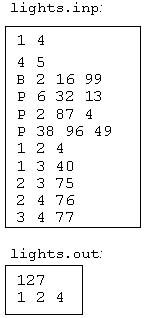
Your program will be allowed to run 2 seconds.
No partial credit can
be obtained for a test case.